    Technical Guides|8 min read

    Commercial Gutter Lining: The Complete Guide for UK Building Owners

    Published 10 April 2026 by Dynamic Commercial Roofing Technical Team · Updated 20 April 2026

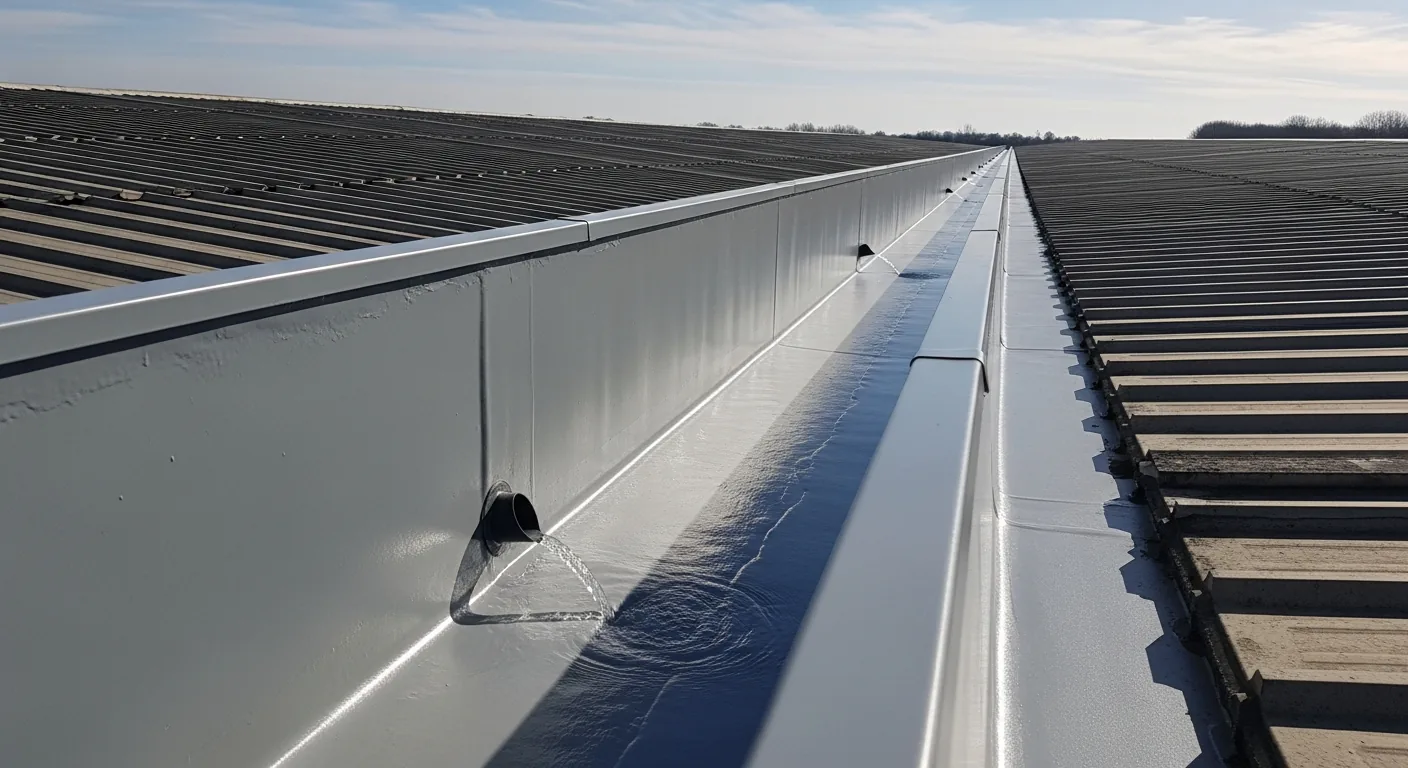
    Wide industrial photograph of a long commercial box gutter on a UK warehouse roof, freshly lined with seamless grey liquid membrane and draining cleanly into an outlet.

    Commercial and industrial gutters take a significant amount of punishment. They handle thousands of litres of rainwater per year, often in a harsh environment, and are expected to perform reliably for decades without attention. When they fail (and they all eventually fail) the consequences can include internal water damage, stock loss, damage to machinery, and even structural deterioration. Gutter lining is the specialist solution that restores failing gutters to watertight condition without the cost and disruption of replacement.

    This guide covers the full picture: why commercial gutters fail, what types can be lined, what the lining process actually involves, how long it lasts, and how it compares cost-wise with full replacement.

    Why Do Commercial Gutters Fail?

    Most commercial gutters fail at the same predictable points: joints, end caps, outlets, corners, and stop-ends. These are the points where sealants were originally applied, and where thermal movement stresses the joint every single day. Over time, typically 10 to 20 years, the original sealants dry out, crack, and begin to allow water through. Once one joint goes, water tracking inside the gutter accelerates failure at the next joint downstream.

    Metal gutters are also subject to corrosion, particularly where standing water sits between cleanouts. Asphalt and lead-lined gutters can crack and delaminate as they age. The cumulative effect is the same: water that should be flowing harmlessly into the downpipes instead tracks behind fascias, saturates insulation, and begins to affect the building structure.

    The other failure mode we see often is blocked outlets. Leaf litter, moss, accumulated silt, and even bird nests can choke a single outlet, which causes the entire gutter to overflow inwards over the wall plate. By the time the leak appears internally, the gutter has been overflowing for months.

    What Types of Gutter Can Be Lined?

    Virtually any commercial gutter type can be lined: box gutters (rectangular cross-section, set within the roof structure), valley gutters (between two pitched roof slopes), parapet gutters (behind a parapet wall), secret gutters (concealed within the roof construction), and half-round or ogee profile fascia gutters. The substrate also does not matter much: liquid lining systems bond effectively to steel, aluminium, GRP, lead, asphalt, and concrete substrates.

    This versatility is one of the great advantages of liquid gutter lining over alternatives like replacement or pre-formed GRP liners. A liquid system conforms to any shape and deals with complex details (corners, outlets, downpipe connections, expansion joints, and penetrations) without the need for fabricated components or specialist welding. It bridges the joints permanently, because there are no joints in the new lining.

    The Gutter Lining Process

    A professional gutter lining project follows a clear, repeatable process. First, the gutters are thoroughly cleaned. Years of debris, silt, biological growth, and old sealant residues are removed by hand and by vacuum. Any structural corrosion or mechanical damage is repaired or reinforced at this stage; we do not bury problems under the new lining.

    Second, the gutter substrate is primed with a system primer matched to the substrate type and the lining product. This is the step most often skipped on cheap installs, and the reason most cheap installs fail at the five-year point.

    Third, the liquid membrane is applied in two coats, with a polyester fleece reinforcement layer fully embedded in the first coat. The fleece does the structural work; the resin is the waterproofing matrix. All outlets, downpipe connections, expansion joints, and penetrations are fully integrated into the seamless liner using detail strips and cured-in-place fleece patches.

    Fourth, a UV-stable topcoat is applied to finish, providing the colour and the long-term weatherproof surface. Finally, every gutter project is water-tested before handover. We literally fill the gutter with water and watch the outlets, then provide photographic documentation as part of the completion pack.

    How Long Does Gutter Lining Last?

    A correctly installed liquid gutter lining system typically performs for the full 20-year guarantee period. The materials are flexible (so they accommodate the daily thermal movement that originally cracked the sealants), UV-resistant, and unaffected by the freeze-thaw cycles that cause rigid sealants to fail. Our gutter lining work is backed by 20-year material guarantees from the system manufacturer.

    The reason a lined gutter outlasts a re-sealed gutter by such a wide margin (5 years vs 20 years) is that lining eliminates the joints entirely. There are no seams to fail, no sealants to dry out, and no edges to corrode. The new gutter is a single, continuous, fully-bonded membrane.

    Gutter Lining vs Gutter Replacement

    Replacing commercial gutters typically involves removing the existing system, disposing of the old materials, supplying the new gutters, and reinstalling, often including significant scaffolding and the disturbance of roof flashings, cladding, and fascias. It is expensive and disruptive. On a typical 200 m run of internal box gutter, full replacement runs to £25,000 to £50,000 and one to three weeks of works.

    Gutter lining, by contrast, typically costs 40 to 60 per cent less than replacement and can be completed with minimal disruption. The existing gutter becomes the structural former for the new seamless liner; the box stays in place, the flashings stay in place, and the lining does the waterproofing work. Most commercial gutter lining projects are completed by a two-person team in a few days using rope access or lightweight MEWP, with no scaffolding, no roof disturbance, and no building closure.

    The exception is where the existing gutter has significant structural damage, severe corrosion through the body of the gutter, or where the substrate cannot support a new lining system. In those cases, replacement may be the right answer. Our surveyors will tell you honestly which option fits your gutter.

    Sector Examples

    Internal box gutters are the dominant gutter type on UK industrial and logistics buildings, and they are the single most common source of internal water damage in those sectors. A lined box gutter eliminates the recurring leaks that those buildings would otherwise experience.

    On education and healthcare sites, parapet and valley gutters are common, often overlooked, and frequently the cause of leaks above clinical or teaching spaces. Lining is particularly suited to these sites because it can be completed in stages, out of hours or in school holidays, and produces no internal disruption.

    What to Specify in a Gutter Lining Quote

    Not all gutter lining quotes are like for like, and the differences hide in the detail. At minimum, the quotation should name the specific liquid system being installed (manufacturer and product reference), confirm the reinforcement (a fleece-reinforced system gives a far more reliable result than an unreinforced coating), specify the dry film thickness in microns, and state the surface preparation method, typically pressure wash plus mechanical abrasion of any corroded sections.

    Equally important is what happens around the outlets and movement joints. A good specification will detail the upgrade or replacement of the outlets themselves (a lined gutter feeding a corroded outlet will simply leak at the outlet within a season), describe how movement joints will be reinforced with a separate detail tape, and list any structural repairs to the gutter sole or upstands that need to happen before lining can begin.

    Finally, the warranty should be a single insurance-backed document covering the system, the workmanship, and the post-completion inspection regime. Beware of quotes that bundle a manufacturer warranty (covering only the materials) with a separate, much shorter contractor warranty (covering the workmanship); the gap between the two is where most lining failures emerge in years three to five.

    Frequently Asked Questions

    How long does commercial gutter lining last?

    A correctly specified and installed liquid gutter lining system typically performs for the full 20-year guarantee period and often beyond. The seamless membrane has no joints to fail, accommodates thermal movement, and is UV-stable, frost-resistant, and immune to the failure modes that cause rigid sealants to crack within five years.

    Can you line a gutter that is already leaking?

    Yes. The lining process starts with a thorough clean and a structural repair stage where any active corrosion, splits, or mechanical damage are addressed before the new lining goes in. The new liquid membrane then bridges every joint, corner, outlet, and expansion joint, including the ones that were previously leaking.

    What sits behind the per-metre price for gutter lining, and at what point does replacement make more sense?

    Gutter lining quotes land between £60 and £150 per linear metre, and the spread within that range is driven mostly by profile, condition, and access. A standard internal box gutter with sound steelwork, a clean substrate, and easy MEWP access from inside the building lands at the bottom end, around £60 to £85 per metre. A complex valley or parapet gutter, with multiple outlets, expansion joints, and rope access from outside, sits at the top end, £120 to £150 per metre, because the prep, the detail tape work around outlets and movement joints, and the access provision all scale up. Gutter condition is the swing factor in the middle of the range: any localised steel repair, outlet upgrade, or joint reinforcement adds £10 to £25 per metre to the line item. As a worked example, a 200 m run of internal box gutter on an industrial unit, in fair condition, accessed from inside, lands at around £14,000 to £18,000 fully inclusive of the 20-year guarantee. The lining-vs-replacement break-even is typically reached when the cost of structural gutter repairs alone exceeds about 40 per cent of the lining quote, or when the surrounding cladding has to come off for unrelated reasons; below that threshold, lining is consistently the cheaper and less disruptive answer, and we will say so on the survey.

    Do you need to remove the existing gutter?

    No. Lining is applied directly into the existing gutter, which becomes the structural former for the new seamless liner. There is no removal, no disposal, no scaffolding, and no disturbance of the surrounding flashings or cladding in the great majority of cases.

    Will the lining work in winter?

    We can install most cold-applied gutter lining systems down to about 5°C, with curing times extended at lower temperatures. We schedule installs to give the lining the best curing conditions, but the materials themselves are designed for UK weather and remain flexible across the full British temperature range once cured.

    Get a Free Gutter Inspection

    Our specialists will assess your gutter condition and advise on the most cost-effective solution. Free inspection, no obligation.