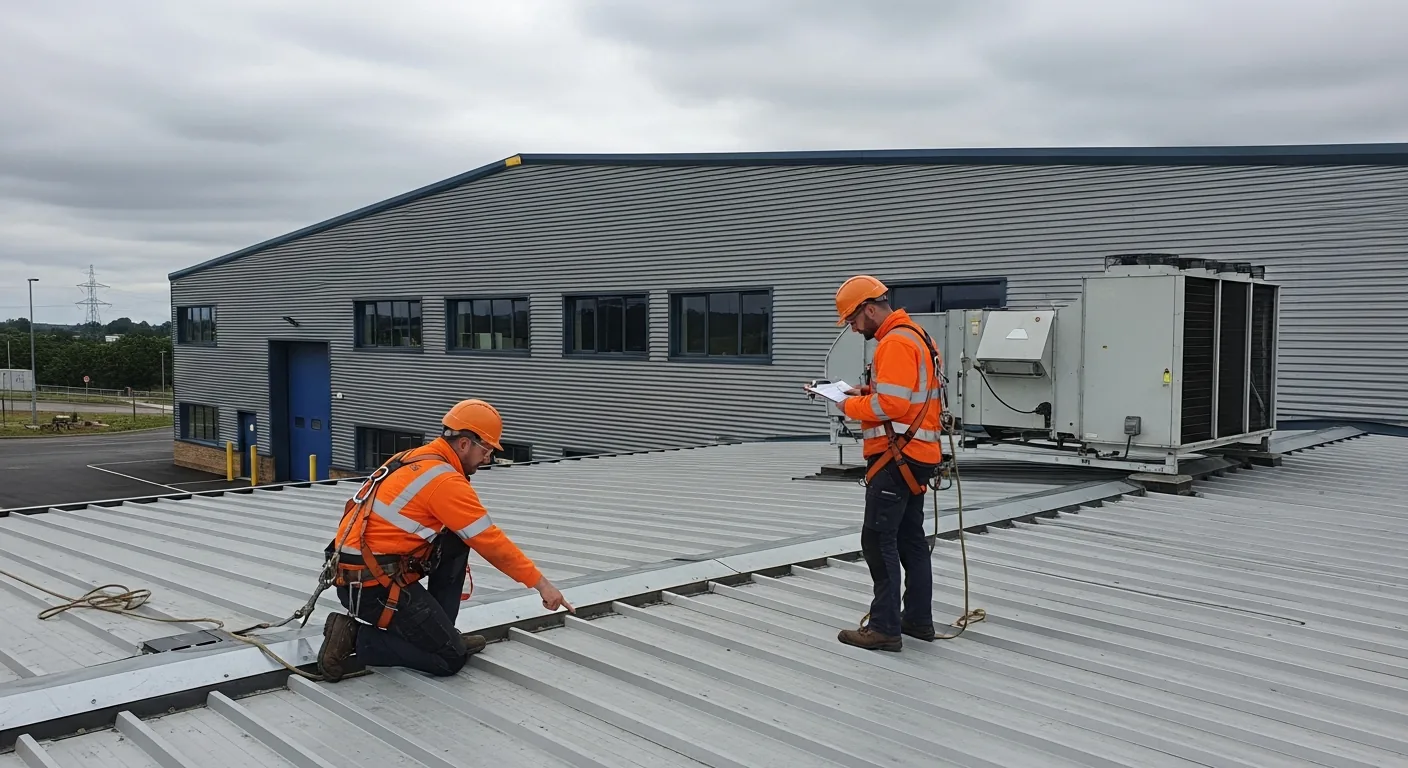
One of the first questions building owners and facilities managers ask us is, "How much will this cost?" It is a fair question, and the honest answer is that commercial roof repair costs in the UK span a wide range, from a few hundred pounds for minor localised repairs to tens of thousands for full system replacement. This 2026 guide gives you realistic benchmarks so you can plan your budget with confidence, understand what drives the price, and avoid the two most common mistakes: overpaying for the wrong specification, or underpaying for work that fails within five years.
The numbers in this guide are based on hundreds of commercial surveys we have completed across the UK, on roofs ranging from 200 sq m corner shops to 25,000 sq m logistics warehouses. We have stripped out the assumptions and given you the real ranges, with the variables that move them.
What Drives Commercial Roof Repair Costs
Five factors do most of the work in setting the price of any commercial roofing project. Roof size is the most obvious; larger roofs need more material and more labour. The extent of the damage matters just as much: a small area of delaminated felt is a very different scope of work from widespread cut edge corrosion across a 5,000 sq ft metal roof. The type of building, the height, and the access conditions are the next big drivers.
Access alone can shift a quote by 30 to 60 per cent. Single-storey industrial roofs that can be reached safely by ladder are straightforward. Multi-storey buildings, occupied schools, live retail premises, or roofs above public areas all add scaffolding, edge protection, traffic management, or rope access, which add real cost. The repair method matters too: cold-applied liquid systems avoid the hot-works fire risk that bitumen torch-on installs carry, which often reduces site costs and insurance premiums.
The fifth factor is the specification itself. A repair backed by a 20-year guarantee is structurally a different product to a quick-fix patch backed by 12 months. Both are legitimate; the right one depends on how long you intend to own or lease the building.
Typical 2026 Cost Ranges by Repair Type
Minor felt or membrane repairs (small patches, flashing replacement, single outlet renewal) typically cost £500 to £2,000 depending on location and access. These are reactive fixes rather than long-term solutions. They are appropriate when the rest of the roof is sound and the leak is isolated.
Full flat-roof refurbishment using liquid waterproofing typically costs £20 to £40 per square metre, including surface preparation, primer, reinforced liquid membrane, and a UV-stable topcoat. For a 500 sq m industrial roof, that is £10,000 to £20,000, often including a 20-year guarantee. The same area replaced with a single-ply membrane and full strip-out usually lands at £55 to £85 per square metre.
Cut edge corrosion treatment on a profiled metal roof generally costs £8 to £18 per square metre, depending on corrosion severity and access. This is far cheaper than re-sheeting, which can cost £40 to £70 per square metre and often demands a temporary roof during the works.
Commercial gutter lining typically falls in the range of £60 to £150 per linear metre, depending on gutter profile, condition, and the system specified. Lining a failing 200 m run of internal box gutter usually costs 40 to 60 per cent less than tearing it out and replacing it.
Asbestos roof encapsulation on cement sheet roofs typically lands at £15 to £30 per square metre, against £50 to £80 per square metre for licensed removal and re-roofing. On a 1,000 sq m school roof, that difference can be £30,000 to £50,000 or more.
Repair, Refurbish, or Replace?
In a clear majority of commercial cases, specialist refurbishment is significantly more cost-effective than full replacement, provided the underlying structure is sound. A liquid waterproofing system applied over an existing flat roof eliminates strip-out costs, waste disposal fees, and the disruption of a full re-roof. Cut edge corrosion treatment can extend a metal roof's life by 20 years at a fraction of replacement cost. Gutter lining can rescue a failing gutter without disturbing the surrounding cladding.
The key is acting before the damage becomes too extensive. Minor corrosion caught early is a straightforward coating job. Left untreated, the same roof can develop structural failures that make full re-sheeting the only viable option. The same applies to flat roofs: blistered felt with isolated leaks can be refurbished; saturated insulation usually cannot.
Our standard advice to facilities managers is to commission an independent condition survey at the 12 to 15-year point on any flat roof, and at 20 years on any profiled metal roof. The survey is the cheapest insurance policy you can buy.
Sector Cost Notes
Industrial and warehousing buildings tend to be the most cost-effective per square metre because the roofs are large, the geometry is simple, and access is straightforward. Our industrial sector page covers the operational planning side of out-of-hours works.
Schools, hospitals, and retail roofs sit at the higher end of the per-metre range. The roofs are smaller, the access constraints are tighter, and we routinely work in term-time, around clinical sessions, or out of trading hours. The education sector and healthcare sector pages explain how we phase works to fit those constraints.
How to Get the Best Value
Always get at least two or three detailed, itemised quotes, not just a single figure. A proper specification tells you exactly what system is being installed, who the manufacturer is, what surface preparation is included, and what warranty you receive in writing.
Be cautious of unusually low quotes that name no specific product system, omit the warranty, or skip surface preparation. In commercial roofing, cheap and fast rarely means good value; the failures show up in years two to four, by which time the original contractor may not be reachable.
Dynamic Commercial Roofing offers free site surveys and no-obligation quotations across the UK. Our technical team will assess your roof, photograph all areas of concern, and provide a clear specification with transparent pricing. If your roof can be saved with a refurbishment system rather than a full replacement, we will tell you, and we will price both options so you can choose with full information.
Budgeting and Procurement Tips
If you manage multiple sites, the single biggest cost lever you have is sequencing the work. We routinely see facilities teams treat each leak as an isolated event and procure each repair independently, which means three or four mobilisation charges, three or four sets of access provision, and three or four warranties from different contractors. Bundling repairs into a single planned visit, with one mobilisation, one access setup, and one warranty, typically saves 15 to 25 percent on the headline figure across a portfolio.
It also pays to understand what is and is not covered by your existing roof guarantee. Many of the post-2010 commercial roofs we survey are still inside a 15 or 20-year manufacturer-backed warranty, but the building owner has lost the original certificate or has used a non-approved contractor for an interim repair, voiding the cover. Before commissioning major works, check whether you hold a live guarantee, and choose a contractor who can carry out the repair within the system warranty. Doing so often turns what would have been a paid repair into a no-cost remedial visit, and it preserves cover on the rest of the roof for the years still to run.
