    Maintenance|7 min read

    Warning Signs Your Commercial Roof Needs Replacing

    Published 26 March 2026 by Dynamic Commercial Roofing Technical Team · Updated 20 April 2026

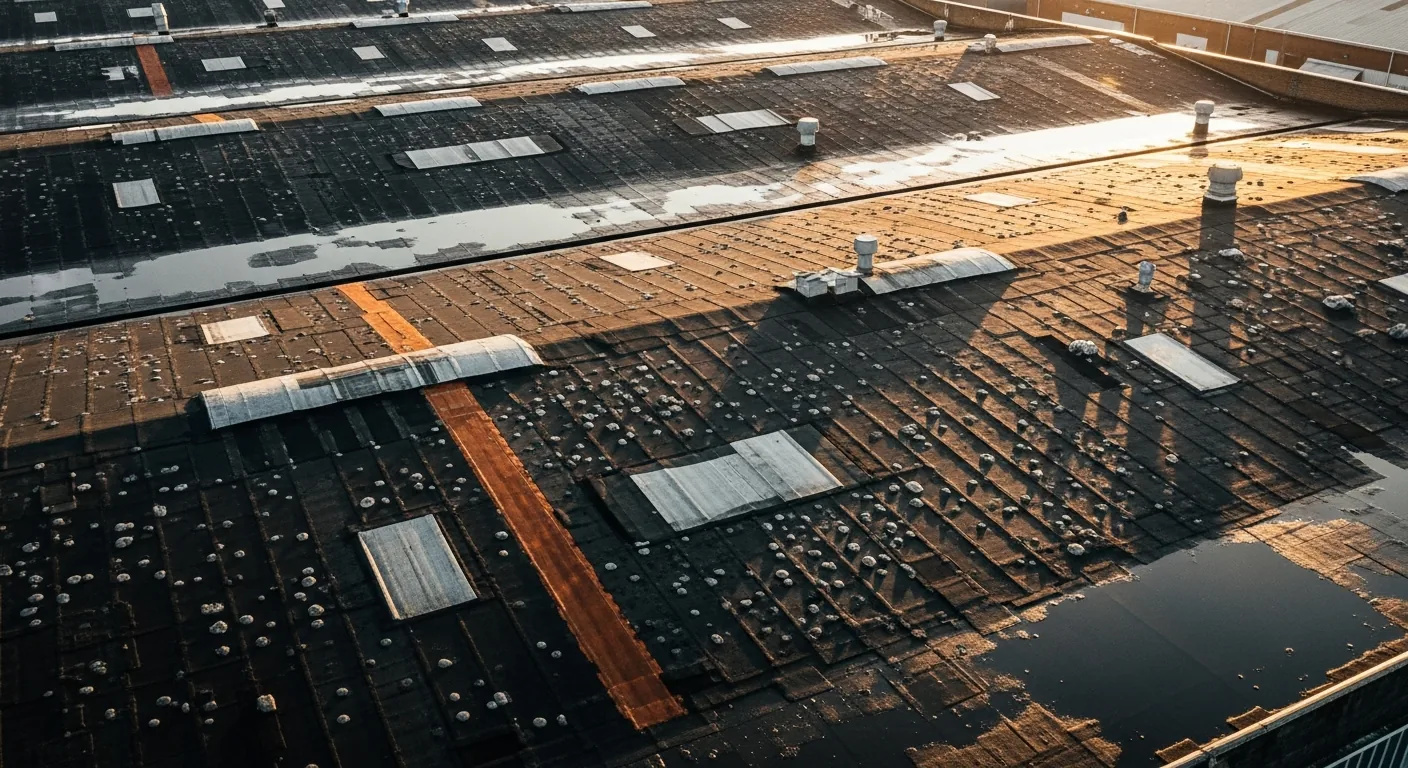
    Aerial drone photograph of a UK warehouse roof showing visible water ponding, blistered black felt, and orange rust streaks running from the metal flashings.

    Commercial roofs have a finite lifespan, and recognising the warning signs early can be the difference between a manageable refurbishment project planned around your operations and an emergency response during your busiest trading period. We survey hundreds of UK commercial roofs every year and see the same warning signs repeated across industrial, retail, education, and healthcare properties. This guide walks you through the signs to look for, what each one usually means, and how urgently you need to act.

    1. Persistent or Recurring Water Ingress

    The most obvious sign of a failing roof is water getting through, but it is the pattern of leaks that matters more than the leaks themselves. A single leak at a known weak point (a flashing, an outlet, or a service penetration) is often a straightforward repair. But recurring leaks in multiple locations, or leaks that return shortly after being patched, almost always mean the waterproofing layer has reached the end of its useful life.

    If your maintenance team is visiting the roof regularly to apply sealant or patch felt, and the leaks keep coming back in different places, the roof is telling you it is past localised repair. The economic argument has shifted from "fix the next leak" to "refurbish before the insurance claims start". Get a professional condition survey before the next storm.

    2. Visible Corrosion on Metal Roofs

    If your building has a profiled metal roof, look at the sheet overlaps, eaves, ridges, and gutters during or shortly after rainfall. Rust-coloured staining running down the wall, or orange streaks in your gutters, indicates cut edge corrosion is underway. This is particularly common on metal roofs installed in the 1980s and 1990s, before edge sealants became standard practice.

    The good news is that cut edge corrosion caught early can be treated at a fraction of the cost of re-sheeting. Treatment typically extends roof life by 20 years for £8 to £18 per square metre, against £40 to £70 per square metre for full re-sheet. Left too long, however, corrosion spreads from the edges into the body of the sheet, perforating the cladding and making full replacement unavoidable.

    3. Ponding Water and Drainage Problems

    Flat and low-pitched roofs should drain within 24 to 48 hours of rainfall under normal conditions. Persistent ponding (standing water visible days after the rain has stopped) indicates either a drainage problem at the outlets or a structural deflection of the roof deck itself. Either way, it is a signal that requires attention.

    Ponding accelerates membrane degradation in three ways: it concentrates UV exposure on the wet surface, it adds significant dead weight (a 10 mm pond on 1,000 sq m is 10 tonnes of standing water), and it increases the chance of freeze-thaw damage in winter. If you notice water still standing on your roof days after dry weather, your drainage outlets and falls should be inspected as a priority.

    4. Blistering, Cracking, or Delamination

    Walk-over inspections, where it is safe to carry them out, often reveal blistering in felt membranes, cracking in asphalt, or delamination of the waterproofing layer from the substrate beneath. These are all signs the membrane has reached the end of its effective life.

    Blisters form when moisture trapped beneath the membrane vapourises in summer heat. Once blisters appear across more than a small percentage of the roof, localised patching is no longer a viable strategy: there is too much trapped moisture, and patches simply move the problem to the next pressure point. The economic answer at that stage is a full overlay system, often using cold-applied liquid waterproofing, which seals over the blistered substrate without strip-out.

    5. Failing Gutters and Internal Box Gutters

    Internal box gutters and valley gutters are the most overlooked failure point on UK commercial buildings. They handle thousands of litres of water per year, the joints flex daily with thermal movement, and the consequences of a gutter leak are often worse than a roof leak because the water enters directly above the building interior.

    Signs of failing gutters include staining on the wall directly below the eaves, water marks on internal ceilings near the gutter line, vegetation growing in the gutter itself, and visible cracks or split sealant at gutter joints. Commercial gutter lining restores failing gutters to watertight condition without removing them, typically at 40 to 60 per cent of the cost of replacement.

    6. The Roof Is Over 15 Years Old

    Even if you have not spotted visible defects, a felt or asphalt roof over 15 years old is approaching the end of its reliable service life. A condition survey at this stage is strongly recommended; it will tell you whether you have five years left or five months. Knowing which is which transforms what would have been an emergency capex bid into a planned, budgeted refurbishment.

    Profiled metal roofs have a longer lifespan, typically 30 to 40 years for the sheet itself, but the protective coating fails earlier and that is what cut edge corrosion measures. A 25-year-old metal roof should be inspected for corrosion at the cut edges, around fixings, and at the overlaps.

    What to Do Next

    If you have noticed any of these signs, the sensible next step is a free professional condition survey. Our technical team provides photographic condition reports across the UK, with a clear assessment of remaining roof life, recommended works, and itemised pricing. The survey itself carries no obligation and no charge.

    Across our industrial, logistics, and public sector clients, the buildings that avoid emergency leaks are almost always the ones whose facilities teams commission a survey at the 12 to 15-year point. The early warning gives you time to budget, to plan around operations, and to choose the most cost-effective intervention rather than the fastest one.

    One more practical point: keep a simple roof maintenance log. Date of last inspection, photos of any defects noted, dates of any repairs, and the contractor who carried them out. When the roof eventually does need a major intervention, that maintenance history is one of the strongest tools your contractor and insurer have for choosing the right specification. It also adds value at sale or refinancing, because incoming buyers and lenders increasingly ask for roof condition documentation as part of due diligence on commercial property.

    Repair, Refurbish or Replace

    Once a survey has confirmed that warning signs are real and not cosmetic, the decision usually comes down to one of three routes. Targeted repair makes sense when the membrane or sheet is fundamentally sound and only one or two areas have failed: think of localised tears around plant penetrations, isolated lap failures, or a single corroded gutter run. Costs are low, lifespan is short (3 to 7 years), and there is no warranty on the rest of the roof.

    Refurbishment, typically cold-applied liquid waterproofing over a flat roof or a treatment plus overcoating system on a metal roof, is the right answer for the majority of buildings whose substrate is sound but whose surface is at end of life. It carries a 20-year guarantee, avoids strip-out, and can usually be sequenced around occupied operations.

    Full replacement is reserved for roofs whose deck, insulation, or structural components have failed, where building regulations or thermal targets force a fully redesigned buildup, or where the existing system is incompatible with any overlay (for example, certain wet or contaminated insulation layers). Replacement is the most expensive route and the most disruptive, but it is also the only honest answer when the underlying structure is no longer fit for purpose.

    Frequently Asked Questions

    How often should a commercial roof be inspected?

    We recommend a professional inspection every two years for commercial flat roofs under 15 years old, and annually thereafter. Profiled metal roofs should be inspected for corrosion every three to five years from year 15 onwards. After any major storm, a walkover check is sensible.

    Can a commercial roof be repaired instead of replaced?

    In the majority of cases, yes. If the underlying structure (deck, insulation, purlins) is sound, a refurbishment system such as cold-applied liquid waterproofing or cut edge corrosion treatment can extend the roof's life by 20 years for far less than the cost of replacement. A condition survey will tell you which option fits your roof.

    How long does it take to replace a commercial roof?

    A full strip and re-roof on a typical UK commercial building takes four to twelve weeks depending on size, access, and the system specified. A liquid overlay refurbishment usually takes one to four weeks for the same building, with much less internal disruption.

    What does a free roof condition survey involve?

    Our surveyor attends site, walks the roof safely (or surveys by drone or rope access where the roof is not safe to walk), photographs all areas of concern, measures key dimensions, and produces a written condition report with recommended works and an itemised quotation. There is no charge and no obligation.

    Will replacing the roof disrupt my business?

    We minimise disruption by working out of hours, in phases, or using cold-applied overlay systems that avoid hot works and produce no smoke or smell. The vast majority of our commercial clients keep their building fully operational throughout the works.

    Book a Free Roof Condition Survey

    Our technical team provides comprehensive condition surveys with photographic reports. No charge, no obligation.