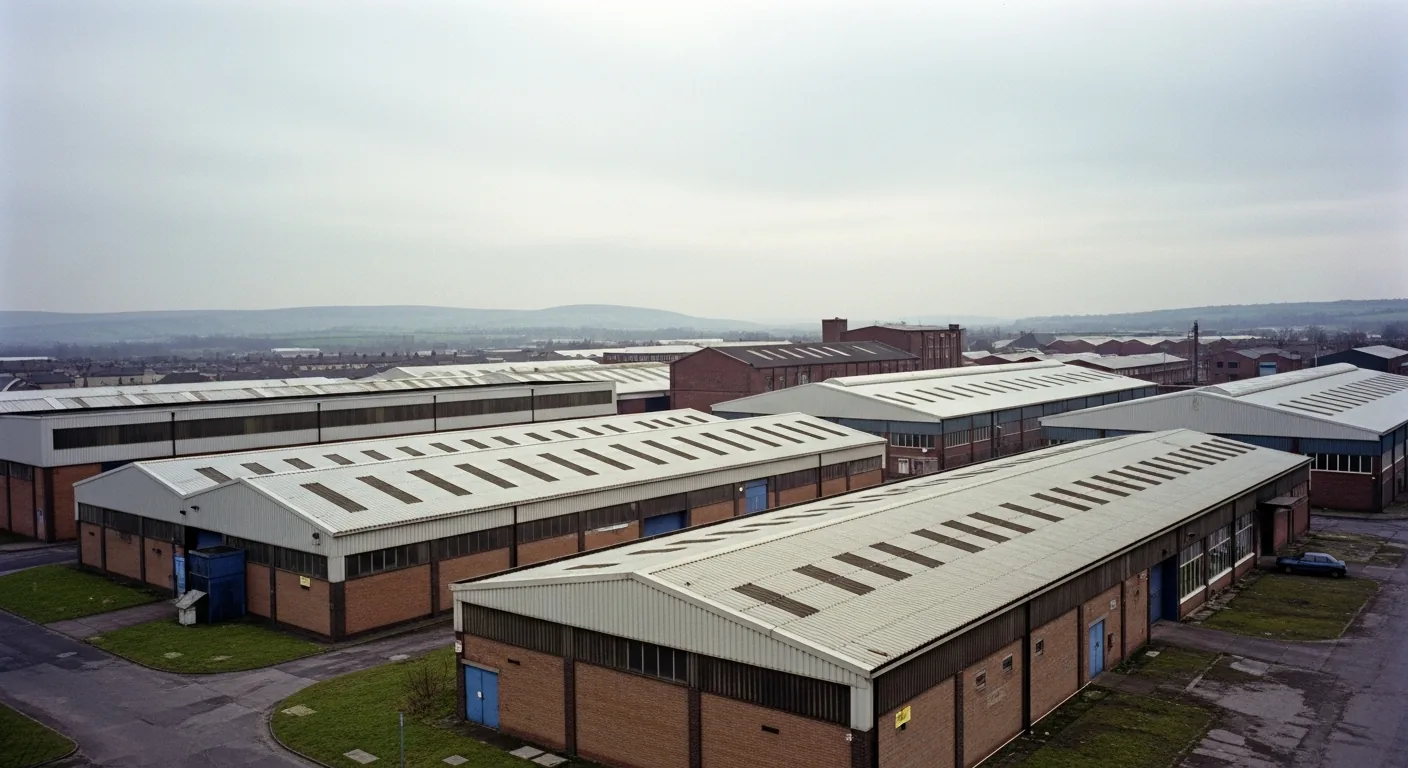
A leak inside a South Yorkshire factory or warehouse does not identify the roof defect by itself. Water can travel along insulation, deck profiles, purlins and internal services before it becomes visible. The stain on the ceiling may therefore be some distance from the entry point.
The useful first question is not which repair product to buy, but what roof construction is present and what evidence explains the symptom. This guide sets out the common areas to investigate on industrial buildings in Sheffield, Rotherham, Barnsley and Doncaster. It cannot replace a site-specific survey, safe access plan or competent asbestos advice.
Start with the symptom, not an assumed solution
Record where water appears, when it happens and what was occurring at the time. Note whether ingress follows prolonged rain, wind-driven rain, snow thaw, gutter overflow or work by another contractor. Marking each internal location on a floor plan is more useful than relying on memory after the event.
Externally, a survey should relate those records to roof falls, outlets, penetrations, upstands, laps, changes in level and adjoining elevations. Safe inspection may also need moisture testing or local opening-up. A visual photograph can show a defect, but it cannot always establish the condition of concealed insulation, vapour control layers or the deck.
Flat roof membrane defects
Industrial flat roofs may have built-up felt, asphalt, single-ply membranes or a previous liquid-applied system. Typical warning signs include open laps, splits around movement points, failed details at kerbs and penetrations, surface blistering, damaged walkways and water remaining around outlets. Ponding is evidence to investigate drainage and falls; it is not proof that one particular membrane treatment will be suitable.
A condition survey should identify the existing build-up, attachment, moisture condition and substrate integrity. Local repair may be appropriate where deterioration is isolated. A compatible overlay or liquid waterproofing system may be considered where the roof and substrate are suitable. Widespread moisture, an unsound deck or repeated failure at structural movement points can change that decision. Our national liquid waterproofing guide explains the technical selection factors in more detail.
Profiled metal roof corrosion and failing details
On profiled metal roofs, inspect sheet ends, side laps, end laps, fasteners, rooflights, flashings and interfaces with gutters. Cut edge corrosion starts where the protective coating has broken down at an exposed sheet edge. Early staining and coating loss are different from advanced section loss or perforation, so the extent must be mapped before a treatment is specified.
Water ingress can also come from loose or deteriorated fasteners, failed lap seals, damaged rooflights or interfaces rather than the corroded edge alone. A coating treatment is not a substitute for replacing material that is no longer sound. See the cut edge corrosion treatment guide for the evidence used to distinguish preparation and coating from more extensive repair.
A confirmed local example is our 12,000m² Doncaster distribution-centre project, where a profiled metal roof was surveyed before a cut edge corrosion treatment specification was prepared. The case study records the project type and scope; it should not be treated as a prediction for a different roof.
Gutters, outlets and industrial roof drainage
Box gutters, valley gutters, outlets and downpipes should be considered as one drainage path. Debris, restricted outlets, defective joints, local corrosion, poor falls and movement at interfaces can all contribute to overflow or leakage. Internal staining near a column or wall may originate from a gutter higher up the roof rather than from the covering directly above it.
The survey should record gutter dimensions and condition, outlet positions, signs of standing water and the route into the below-ground drainage system. Cleaning or a local repair may resolve some defects. A lining system depends on the gutter substrate, structure, falls, outlets and movement details being suitable; a structurally unsound or undersized gutter may require a different response. Our commercial gutter lining guide covers those specification questions.
Asbestos-cement roofs and fragile surfaces
Some older industrial buildings have asbestos-cement roof sheets, rooflights or associated components. Do not assume their presence from age or appearance alone. Check the building's asbestos register and survey information before planning intrusive inspection, cleaning, drilling or repair.
Asbestos-cement sheets may also be fragile. Roof access must be planned around work-at-height and fragile-surface risks, whether asbestos is present or not. Encapsulation is not automatically suitable: material condition, the proposed work, future maintenance and competent advice must determine the management option under the Control of Asbestos Regulations 2012 and relevant HSE guidance. The asbestos roof encapsulation guide explains these limits.
What facilities managers should prepare for a survey
Before the visit, gather the roof plan if available, the asbestos register, previous repair records, product or guarantee documents, drainage maintenance records and photographs taken safely from accessible positions. Provide a simple leak log showing dates, internal locations and weather conditions.
Also identify operational constraints: production areas that cannot be entered, hygiene or permit requirements, delivery movements, fragile-roof information, known electrical or process hazards and acceptable access times. These details help the surveyor plan access and separate the roof diagnosis from programme assumptions.
After the survey, ask for a scope that identifies the observed defects, investigation limits, proposed preparation, named system or materials, details and interfaces, access assumptions, exclusions, programme factors and any guarantee terms. Quotations are easier to compare when each contractor is pricing the same evidence-led scope. Our free commercial roof condition survey sets out the photographic findings, risk-rated defect list and costed proposal we provide for repair and refurbishment advice.
Repair, refurbish or replace?
Local repair can be proportionate when the defect is isolated and the surrounding roof remains serviceable. Refurbishment may be considered where the existing construction can safely receive a compatible system and the details can be resolved. Replacement may be the better option when deterioration is widespread, the deck or insulation is unsound, drainage needs fundamental alteration or the existing build-up cannot support the proposed system.
For South Yorkshire building owners considering a local survey, the South Yorkshire commercial roofing hub explains the regional service routes. If the survey points specifically towards a suitable membrane refurbishment, see the South Yorkshire liquid waterproofing page.
A second confirmed local example is the 8,400m² Rotherham industrial liquid-waterproofing project. The roof was surveyed to establish the existing covering and details before a liquid system was specified. As with the Doncaster example, suitability and scope remain specific to the individual building.