    Technical Guides|7 min read

    What Is Cut Edge Corrosion? Causes, Risks & Treatment

    Published 2 April 2026 by Dynamic Commercial Roofing Technical Team · Updated 20 April 2026

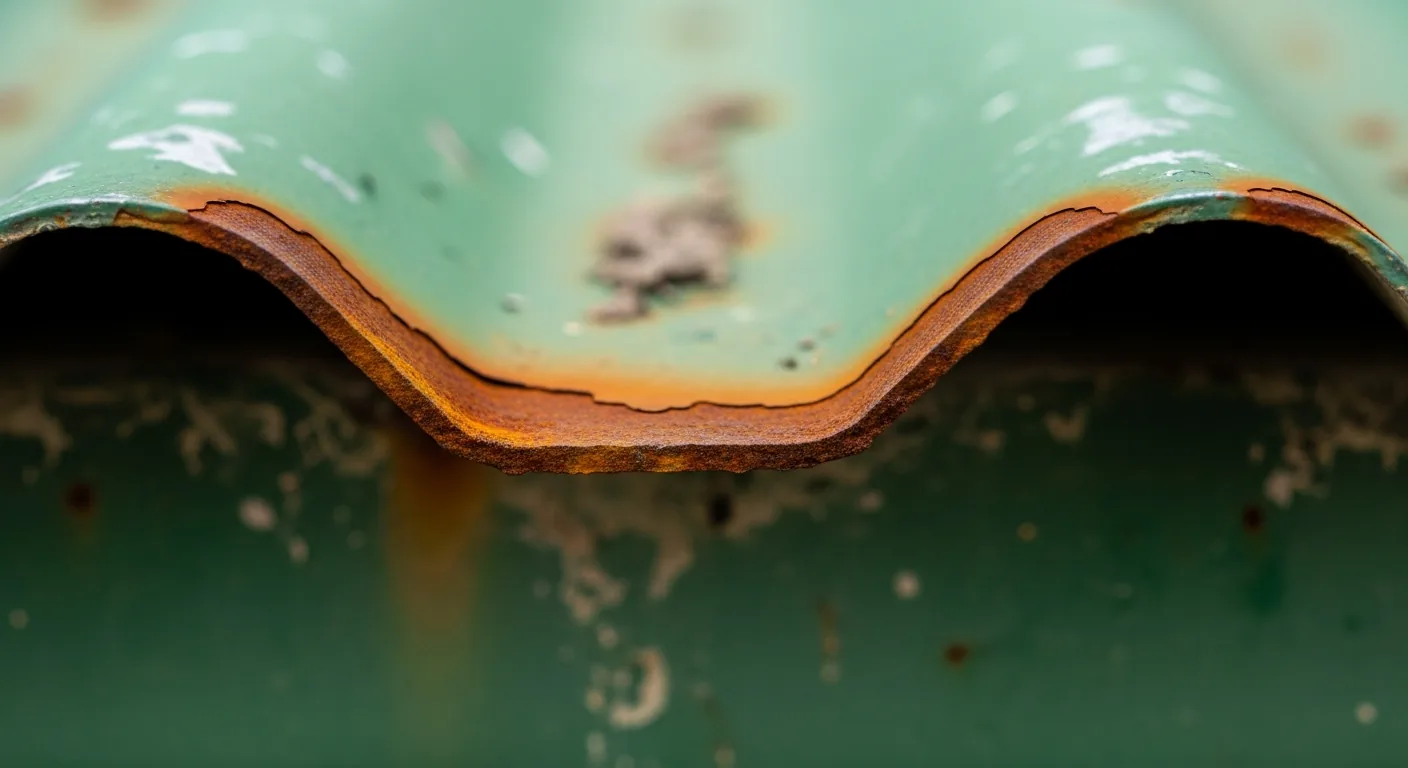
    Macro close-up of cut edge corrosion on a green-painted profiled metal industrial roof sheet, showing orange rust spreading along the cut edge.

    If your building has a metal profiled roof (the type with corrugated or trapezoidal steel or aluminium sheets), there is a reasonable chance it has cut edge corrosion, whether you have noticed it yet or not. Industry estimates suggest the majority of metal roofs installed in the UK before the year 2000 now have some degree of cut edge corrosion present. Understanding what it is, why it happens, and what to do about it can save your business significant money and avoid an unnecessary full re-roof.

    What Is Cut Edge Corrosion?

    Profiled metal roof sheets arrive at site with a protective coating, typically plastisol, polyester, or PVDF, that covers all faces of the sheet. The coating provides the colour, the UV protection, and the corrosion barrier. When sheets are cut to length during installation (which they always are, to fit the roof geometry), the cut edges are left exposed. These exposed steel or aluminium edges have no protective coating and are directly vulnerable to moisture.

    Over time, moisture causes oxidation (the familiar orange rust) at these exposed edges. As the rust expands, it lifts the surrounding protective coating, exposing more metal beneath. This "creep" process spreads inwards from the sheet edges, across the overlap areas, and eventually into the body of the sheet itself. Once the body of the sheet is compromised, the roof is approaching the point where treatment is no longer sufficient and full re-sheeting is the only option.

    Why Does It Happen?

    Cut edge corrosion is not a sign of poor-quality materials or bad installation in most cases. It is simply the result of cuts made during installation not being treated with edge sealant. On older roofs, edge sealing was rarely specified. Even on newer installations, edge sealing is sometimes omitted, done poorly, or applied with a sealant that does not last 20 years.

    The rate of corrosion depends on location, age, coating type, pitch, and drainage. Coastal sites and industrial areas with high airborne salt or pollution accelerate the process. South-facing slopes that drain freely tend to fare better than north-facing slopes that retain moisture longer and never get the UV exposure that helps dry the surface. The most aggressive case we see is north-facing slopes on coastal industrial estates: corrosion progresses three to four times faster there than on a sheltered inland south-facing roof.

    The Risks of Leaving It Untreated

    In the early stages, cut edge corrosion is largely aesthetic: rust staining on the cladding and orange streaks in the gutters. But the visible staining is the surface symptom; the actual corrosion is undermining the mechanical interlock between overlapping sheets, creating pathways for water ingress along the laps.

    Once water starts getting through, the damage accelerates quickly. Internal insulation becomes saturated and loses its thermal performance, sometimes by 50 per cent or more. Steelwork purlins begin to corrode. Stored goods, machinery, and interior finishes are at risk. By the time a leak is reported internally, the roof above may already have lost significant structural integrity, which then governs whether a treatment programme is still viable or whether re-sheeting is the only safe option.

    There is a secondary risk too: insurance. Several UK commercial insurers now require roof condition reports as part of policy renewal on buildings over 25 years old. A documented cut edge corrosion problem with no treatment plan can affect premiums and, in extreme cases, cover.

    How Cut Edge Corrosion Is Treated

    The standard treatment involves five stages. Stage one is a thorough inspection to identify the extent of corrosion and confirm the body of the sheet is still sound. Stage two is mechanical preparation: wire brushing and cleaning to remove all loose rust and contamination. Stage three is application of a rust-inhibiting primer to stabilise the metal. Stage four is reinforced mastic tape applied to the cut edge and lap detail. Stage five is two coats of an elastomeric polymer topcoat, colour-matched to the existing cladding, sealing the edge and overlap areas back to a fully weathertight condition.

    Our cut edge corrosion treatment programmes are typically completed without scaffolding. Our rope-access trained technicians can safely access most commercial roof areas, which significantly reduces project cost compared with quotations that automatically assume full scaffolding. Treatments are colour-matched to the existing cladding so the finished roof looks visually consistent, and they are backed by a 20-year performance guarantee.

    The works are usually completed in one to four weeks for a typical industrial unit, weather permitting, and produce no internal disruption: there are no hot works, no smoke, no smell, and no need to evacuate the building below.

    When Treatment Is Not Enough

    If corrosion has advanced to the point where the body of the sheet is perforated or structurally compromised (rather than just the edges and overlaps), treatment alone may not be sufficient. In those cases, over-cladding (adding a new layer of profiled sheeting over the existing roof) or full re-sheeting may be required.

    A thorough condition survey will tell you exactly where you stand. Our surveyors photograph and document every area of concern, measure coating thickness on representative panels, and provide a clear recommendation: treat, over-clad, or re-sheet. We will not recommend a full re-sheet on a roof that can be saved with treatment, and we will not recommend treatment on a roof that needs re-sheeting. Both are equally costly mistakes.

    Sector Notes

    Cut edge corrosion is the single most common roof issue across our industrial and logistics clients, where 1980s and 1990s metal-clad sheds dominate the building stock. On those buildings, a planned treatment programme on a five to seven-year cycle effectively extends roof life indefinitely at a fraction of replacement cost.

    In the retail and education sectors we see a slightly different pattern: the metal roofs are typically smaller and more accessible, so corrosion is often spotted earlier (during routine fabric surveys, condition reports, or even by the FM team), but they also sit above occupied or revenue-critical areas, which makes the cost of leak-related disruption disproportionately high. Treatment on those buildings is usually scheduled outside of trading or term hours and completed in a single short visit per affected slope.

    What a Treatment Programme Looks Like in Practice

    The first step on any portfolio is a baseline survey across every slope of every roof. We grade each slope on a simple 1 to 5 scale: 1 means coating intact and corrosion only just starting at the cut edge, 5 means active perforation and water entry. That single grading exercise is usually enough to turn a vague sense that the roofs are getting old into a five-year capital plan with hard numbers attached.

    From there we typically split the portfolio into three tranches. Grade 4 and 5 slopes are treated in year one to stop active leaks; grade 3 slopes are treated in years two and three to prevent escalation; grade 1 and 2 slopes are placed on a monitoring cycle and re-graded every three years. This phased approach spreads the spend, prioritises buildings most at risk, and allows the FM team to align the work with their existing planned-maintenance budget cycles rather than competing with reactive emergency spend.

    Crucially, the same survey often identifies adjacent issues that can be addressed in the same visit at marginal extra cost: rooflight replacement, gutter clearance, fall-arrest upgrades, and lightning-protection bonding. Bundling those together can deliver a fully refurbished roof envelope in a single mobilisation, with one warranty package and one set of access costs.

    Frequently Asked Questions

    How can I tell if my metal roof has cut edge corrosion?

    The easiest visible sign is rust-coloured staining running down the cladding from the sheet edges and orange streaks in the gutters during or after rainfall. A close-up inspection of the sheet overlaps, eaves, and ridges will usually confirm whether the protective coating is lifting at the cut edges. A free survey is the fastest way to get a definitive answer.

    How long does cut edge corrosion treatment last?

    Our treatment systems are guaranteed for 20 years via a guarantee. The treatment halts active corrosion, seals the cut edge with specialist mastic tape and primer, and applies a reinforced polymer topcoat that prevents moisture re-entry for the full guarantee period. With routine gutter clearance, the treatment regularly outlasts the guarantee.

    What drives the price of cut edge corrosion treatment, and where would my building sit in the range?

    Three variables move the per-square-metre price within the £8 to £18 range. The first is corrosion grade: a grade 1 or 2 slope (coating lifting at the cut edge, no perforation) sits at the bottom of the range, around £8 to £11 per sq m, because the prep is a clean and degrease, a single edge tape, and a topcoat. A grade 4 or 5 slope (active rust through the sheet, lap separation, water entry) sits at £14 to £18 per sq m once you add wire-brushing, isolated sheet replacement, additional reinforcement, and a heavier topcoat film build. The second variable is access: a single-storey shed worked from a MEWP is at the cheap end; a multi-storey unit needing rope access, edge protection, or scaffolding can add £3 to £6 per sq m on top. The third is the system itself, where a fleece-reinforced two-coat polyurethane carries a small premium over a single-coat acrylic but extends warranty life from 10 to 20 years. As a worked example, a 3,000 sq m industrial unit graded mostly 2 with a few 4 slopes, accessed by MEWP, on the standard 20-year reinforced system, comes in around £33,000 to £42,000 inclusive of the manufacturer-backed guarantee. Once any single building's quote starts approaching the £25 to £30 per sq m mark, cut edge treatment is no longer the most economic answer and a re-sheet should be priced alongside it.

    Will cut edge corrosion treatment disrupt my operations?

    No. The works are entirely external, use cold-applied materials with no naked flame and no smoke, and produce no smell or vibration internally. Our rope-access teams typically complete the works without scaffolding, so there is no impact on yard operations either.

    Is cut edge corrosion treatment cheaper than replacing the roof?

    Significantly cheaper. Treatment typically costs 20 to 30 per cent of the cost of a full re-sheet, with no internal disruption, no temporary roof, and no business interruption. Replacement only becomes the right answer when the body of the sheet is structurally compromised.

    Get a Free Cut Edge Corrosion Assessment

    Our specialist team will photograph and assess all areas of corrosion and provide a detailed treatment specification.